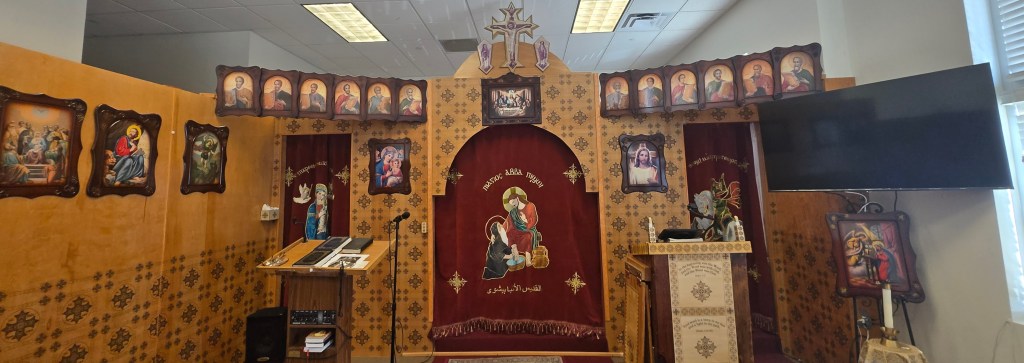

All are welcome to attend and pray with us. Our community includes lifelong Orthodox Christians as well as those who are new to the faith or exploring it for the first time.
We are always glad to receive visitors, seekers, and anyone interested in learning about the Coptic Orthodox Christian tradition. If you have questions about the service, faith, or practices of the Church, the clergy and members of the community will be happy to speak with you and help explain what we do and why.
We ask all visitors to dress in a way that is respectful and modest, as is fitting for worship. Many people choose business-casual clothing, but the most important thing is simple, modest attire that reflects reverence in the house of God.
In the Coptic Orthodox Church, Holy Communion is understood as the true Body and Blood of Christ, not a symbolic act. Because of this, participation in the Eucharist is reserved for baptized Orthodox Christians who are spiritually prepared.
Preparation includes living in peace with others, regular confession, keeping the fasts of the Church as applicable, and arriving on time for the Divine Liturgy.
At the end of the service, all visitors—Orthodox and non-Orthodox alike—are welcome to receive blessed bread (often called the Eulogion), which is shared as a sign of fellowship.
You are welcome to participate as you feel comfortable. Many people stand, sit, make the sign of the cross, and follow along with the hymns.
Some of the chants and responses may be unfamiliar at first, but participation is encouraged as a way to learn. The Divine Liturgy is typically about 2½ to 3 hours long.
Coptic Orthodox worship is primarily sung and chant-based. The congregation participates actively through responses and hymns, supported by deacons and a choir.
Traditional percussion instruments such as cymbals and the triangle are used to maintain rhythm during chanting. The music is intended to be prayerful and reverent, helping guide the faithful into worship and reflection before God.
Standing is the traditional posture for prayer in the Orthodox Church, with occasional bows during specific moments of the service.
That said, visitors are not expected to know every detail. You are welcome to sit or stand as needed, especially if you are new or unfamiliar with the service flow.
After the Divine Liturgy, the community often gathers for fellowship, conversation, and a shared meal.
This is a time to meet others, ask questions, and spend time together. Food and basic facilities are available at the church, and guests are warmly invited to stay and socialize.
Resources
10 Things I wish I’d known before attending an Orthodox Liturgy
Touring a Coptic Church to Learn about Coptic Worship
A Protestant talks with a Coptic Priest